Raftel Assay v0.1, open source, in pre-release
Find the broken episodes before you train on them.
Raftel Assay is quality control for robot learning data. Point it at a LeRobot dataset and every episode gets pass, warn or fail, with the frame, the measured value and the threshold behind it.
- Apache 2.0
- Runs locally, nothing uploaded
- LeRobot v3.0, v2.1, v2.0
The cost of bad episodes
You pay once to collect a bad episode and again to train on it.
None of these defects crash training. They quietly teach the policy the wrong thing, and nobody finds out until the GPU bill is paid. Most teams catch them by scrubbing video by hand, if at all. Assay checks every episode the same way, every time, and says exactly where it looked.
AC001A NaN in one action, at one frameVQ001A camera that recorded blackDU002The same demo uploaded twiceID002A robot standing still for the first 4 secondsSY006Video frames that drift out of step with the dataTS001Timestamps that run backwards after a bad merge
Usable-hour calculator
Real cost of each usable hour
More than the price you were quoted
usable-hour cost = paid per hour ÷ (1 − share dropped)
How Assay works
One command runs nine read-only checks and gives every episode a verdict you can act on.
-
01
Point it at a dataset
A local LeRobot folder or a Hugging Face Hub id. Versions 3.0, 2.1 and 2.0 are read natively.
$ raftel assay lerobot/pusht --out out/ -
02
Nine checks run, read only
Structure, timing, camera sync, actions, idle time, video quality, duplicates, metadata and license. Your dataset is never modified.
-
03
Verdicts you can act on
A terminal summary, a single-file HTML report,
assay.jsonfor CI, and a keep list of the episodes worth training on.report.htmlassay.jsonkeep_episodes.json
- readerknows formats
- Episodeone shared model
- checksknow physics
- runnersets verdicts
- outputsjson, html, keep
Readers know formats, checks know physics, and neither knows about the other. A new format gets every check for free, and a new check works on every format.
Verdicts, acted out
Assay's verdict logic, acted out by a simulated ARM-01: every sample is scanned, passes and warnings are kept, and a failure goes in the reject bin.
- PASS kept
- WARN kept, flagged amber
- FAIL rejected
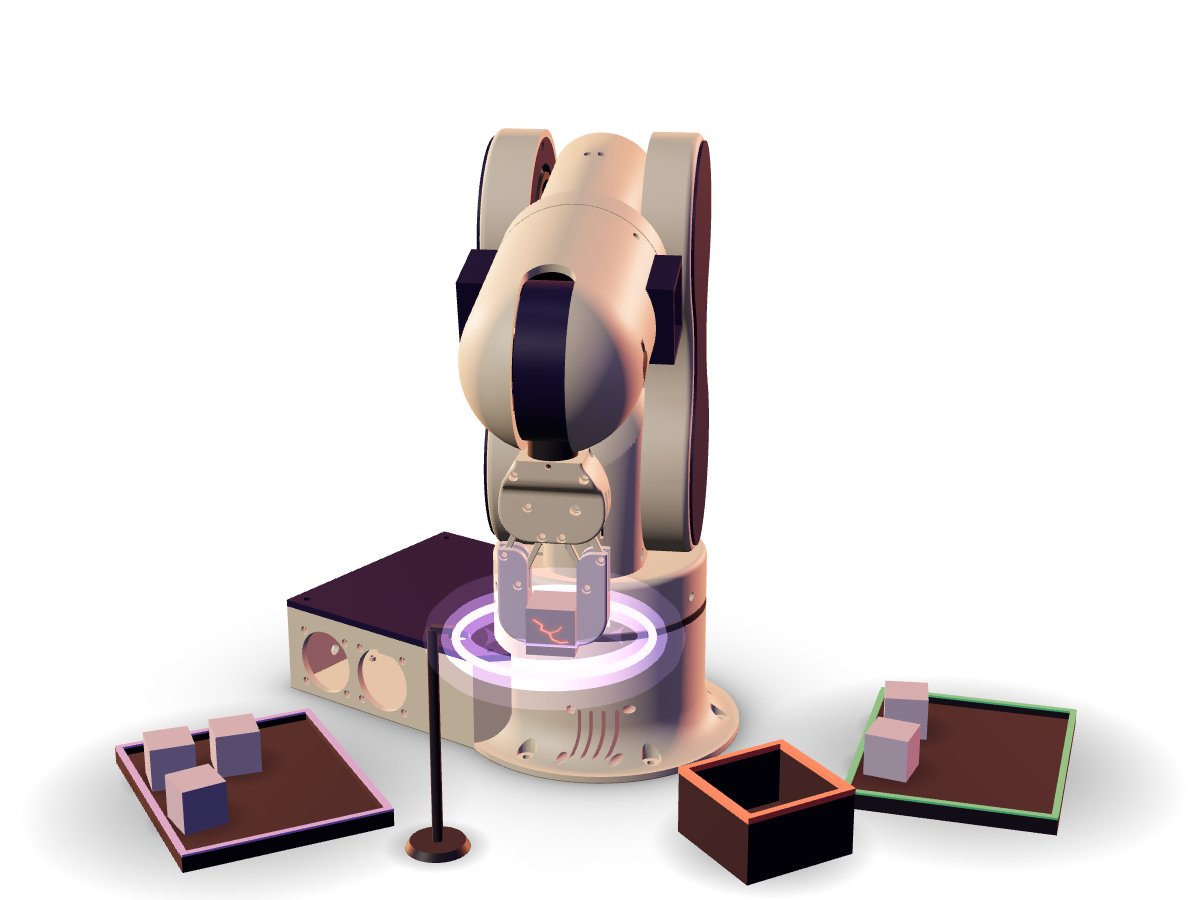
Illustration, simulated.
Nine checks
Each check has a two-letter prefix, a written rule and a documented threshold. Findings carry stable codes like AC001, so the same problem always reads the same way.
ST
structureFAILFrame index gaps, row counts that disagree with the declared length, a broken global index.
TS
timestampsFAILWARNTime running backwards or repeating, gaps, FPS drift from
info.json.SY
syncFAILWARNVideo frame counts or durations out of step with the data rows, missing mp4 files.
AC
actionsFAILWARNNaN or Inf values, actions that never change, joints that teleport between two frames.
ID
idleFAILWARNA robot that never moves, long idle starts or ends, truncated or unusually long episodes.
VQ
video_qualityFAILWARNBlack, blown-out, frozen or blurry frames, sampled per camera and per episode.
DU
duplicatesFAILWARNThe same episode recorded or uploaded twice, found by trajectory fingerprint and frame hashes.
MD
metadataFAILWARNMissing task text, schema mismatches, wrong totals, missing or stale stats.
LI
licenseWARNMissing, unknown, non-commercial or no-derivatives licenses on the dataset card.
48 finding codes, each with its exact rule, default threshold and the reason for that value.
Read the checks referencePrinciples
A false pass costs more than a missing feature. QC is only useful if you can trust the verdict, so these rules are enforced in the code and the tests.
Fail means objectively broken
Statistical rules only ever warn. A fail is something you could show a colleague and they would agree on sight.
No silent passes
Without video support, or with
--no-video, frame checks are reported as skipped and the report says “video not checked.”Every verdict is reproducible
Each finding carries its code, the value it measured and the threshold it crossed. Every threshold used is written into
assay.json.Read only, local, private
Your dataset is never modified. No telemetry, no uploads. The only network call is a Hub download you asked for.
Dataset findings stay dataset findings
A license warning describes the dataset. It never fails episode 12.
Simple math you can explain
Every check ships with a written rule, a test that plants the defect, and a test that a clean episode passes.
Sample report
One self-contained HTML file. It opens offline, and you can sort and filter every episode.
This report comes from the same 8‑episode run as the scan at the top of the page: a synthetic LeRobot v3 dataset with four planted defects. Assay v0.1 caught all four and flagged nothing else.
- ep 2NaN in one action at frame 45AC001
- ep 4Idle for the first 120 framesID002
- ep 5Exact duplicate of episode 0DU002
- ep 6All 8 sampled frames blackVQ001
Install and run
Run it by hand, gate a pull request on it, or call it from Python. Exit codes are stable, so CI can trust them.
Exit codes
0Scan finished, nothing at or above--fail-on1A finding hit--fail-on(default: fail)2Tool error: bad usage or unreadable dataset
Formats
- LeRobot v3.0Supported
- LeRobot v2.1, v2.0Supported
- RLDS, MCAP, ROS 2 bagsPlanned
# [video] adds PyAV + Pillow for the frame checks
$ pip install "raftel-assay[video]"
$ raftel assay ./my_dataset --out out/

# or straight from the Hugging Face Hub
$ pip install "raftel-assay[video,hub]"
$ raftel assay lerobot/pusht --out out/
$ raftel assay ds --out out --keep-list
Raftel Assay 0.1.0.dev0
Dataset : ds
Format : lerobot_v3 (v3.0), fps 30
Episodes: 8 PASS 4 WARN 1 FAIL 3
Time : 0.3 s
Checks : structure, timestamps, sync, actions, idle, video_quality, duplicates, metadata, license
Dataset findings (do not change episode verdicts):
INFO [LI005] declared license: apache-2.0 (as stated in the dataset card, not verified)
Episode findings by code:
FAIL AC001 1 episode 1 NaN/Inf value(s) in action across 1 frame(s)
FAIL DU002 1 episode exact duplicate of episode 0 (same trajectory and same video frames)
FAIL VQ001 1 episode 8/8 sampled frames are black (first: mean 0.0, std 0.0; limits mean < 10, std < 5)
WARN ID002 1 episode robot idle for the first 120 frames (4.0s)
Flagged episodes:
ep 2 FAIL [AC001] 1 NaN/Inf value(s) in action across 1 frame(s) (value 1, limit 0) at frames 45-45
ep 5 FAIL [DU002] exact duplicate of episode 0 (same trajectory and same video frames) (value 0)
ep 6 FAIL [VQ001] 8/8 sampled frames are black (first: mean 0.0, std 0.0; limits mean < 10, std < 5) at camera observation.images.top, frame 5
ep 4 WARN [ID002] robot idle for the first 120 frames (4.0s) (value 120, limit 90) at frames 0-120
Wrote out/assay.json
Wrote out/report.html
Wrote out/keep_episodes.json{
"schema_version": 1,
"tool": "raftel-assay",
"format": "lerobot_v3",
"summary": { "episodes": 8, "pass": 4, "warn": 1, "fail": 3 },
"config": { "gap_factor": 1.5, "jump_frac": 0.5, ... },
"episodes": [
{
"episode_index": 2, "length": 90, "verdict": "fail",
"findings": [
{ "check": "actions", "code": "AC001", "severity": "fail",
"message": "1 NaN/Inf value(s) in action across 1 frame(s)",
"value": 1, "threshold": 0, "frame": 45, "frame_end": 45 }
]
}
]
}# .github/workflows/data-qc.yml
name: data-qc
on: [pull_request]
jobs:
assay:
runs-on: ubuntu-latest
steps:
- uses: actions/checkout@v4
- uses: actions/setup-python@v5
with: { python-version: "3.12" }
- run: pip install "raftel-assay[video]"
- run: raftel assay ./data/my_dataset --out qc --fail-on fail
- uses: actions/upload-artifact@v4
if: always()
with: { name: assay-report, path: qc/ }from raftel_assay import run_assay
result = run_assay("./my_dataset")
print(result.counts(), result.keep_episodes())
# or read the CI contract directly
import json
result = json.load(open("qc/assay.json", encoding="utf-8"))
bad = [e["episode_index"] for e in result["episodes"] if e["verdict"] == "fail"]v0.1 is in pre-release. The public PyPI and GitHub release is planned for January 2027.
Working in a coding agent? Copy a ready-made prompt.
Prompts for your coding agent
Paste one into Claude Code, Cursor, Codex or any agent that can run a shell. Each one uses real flags, keeps your dataset read only, and tells the agent where to find the answer.
Run Raftel Assay on ./data/my_dataset and tell me what's wrong with it.

1. Install it if it's missing: pip install "raftel-assay[video]"
2. Run: raftel assay ./data/my_dataset --out qc --keep-list
3. Read qc/assay.json. Give me the pass, warn and fail counts, then group the flagged episodes by finding code, with the frame, measured value and threshold for each one.
4. List dataset-level findings (MD and LI codes) separately. They never change an episode's verdict.

Don't modify, move or delete anything in the dataset.
raftel assay ./data/my_dataset --out qc --keep-listEpisode 2 in qc/assay.json was flagged. For each of its findings: - Say in plain words what the finding code means. The reference is https://raftel.si/checks - Compare the measured value with the threshold it crossed. - Give the most likely cause during recording or export. - Tell me how to confirm it by eye, and at which frame. If video checks were skipped in this run, say so. Don't change the dataset.
qc/assay.jsonraftel.si/checksAdd a GitHub Actions workflow at .github/workflows/data-qc.yml that runs on pull requests and: - sets up Python 3.12 and runs: pip install "raftel-assay[video]" - runs: raftel assay ./data/my_dataset --out qc --fail-on fail - uploads qc/ as an artifact named assay-report, even when the scan fails Exit code 1 means a finding hit --fail-on, and 2 means a tool error. Both should fail the job. Show me the file before you commit it.
raftel assay ./data/my_dataset --out qc --fail-on failRun: raftel assay ./data/my_dataset --out qc --keep-list Then update the training script so it only loads the episodes listed in qc/keep_episodes.json. The "kept" field is a list of episode indices; pass it to LeRobotDataset's episodes argument. Print how many episodes were dropped and the reasons listed under "dropped". Leave the dataset files untouched.
raftel assay ./data/my_dataset --out qc --keep-listBefore we train on lerobot/pusht, check it: 1. pip install "raftel-assay[video,hub]" 2. raftel assay lerobot/pusht --out qc/hub --keep-list 3. Tell me how many episodes are usable, which finding codes show up most, and any license warnings (LI codes) that affect commercial use. End with a short go or no-go and the reasons for it.
raftel assay lerobot/pusht --out qc/hub --keep-listEpisode 4 was flagged ID002, but I think the data is fine. 1. Re-run just that check on that episode: raftel assay ./data/my_dataset --out qc/recheck --only idle --episodes 4:5 2. Show the measured value and threshold from qc/recheck/assay.json. 3. Look at the raw data for that episode and tell me whether the finding holds up. 4. If it doesn't, draft a short false-positive report: code, episode, value, threshold, and why the data is actually fine.
raftel assay ./data/my_dataset --out qc/recheck --only idle --episodes 4:5Teach the agent the rules once
Paste this into the AGENTS.md or CLAUDE.md at the root of your repo. Every later session then knows to run Assay before training, how to read the exit codes, and never to “fix” a dataset by deleting files.
These prompts assume the PyPI package, which ships with the public release in January 2027.
## Robot data QC (Raftel Assay)

- Before training on, merging or publishing a dataset, run:
  raftel assay <dataset> --out qc --keep-list
- Exit codes: 0 clean, 1 a finding hit --fail-on, 2 tool error.
  Never treat 2 as a pass.
- Results are in qc/assay.json. Finding codes are documented at
  https://raftel.si/checks
- FAIL means objectively broken. WARN means a person should look.
  MD and LI findings describe the dataset and never fail an episode.
- If video checks were skipped (--no-video, or PyAV missing), say
  "video not checked" instead of calling the data clean.
- Assay is read only. Never edit or delete dataset files to make a
  check pass; filter with qc/keep_episodes.json instead.
Dataset audits
For teams that collect robot data, and teams that buy it or train on it. We run Assay on your private data and answer the question that matters: how much of what you paid for is trainable?
What arrives in 5 business days
- A verdict for every episode, with the reason and frame
- Your usable-hours figure
- An HTML report with thumbnails of the 20 worst episodes
assay.jsonfor your pipeline or CI- A clean keep list or filtered LeRobot v3 export
- A 30-minute readout with root-cause notes for your collection process
How it starts
Scoping call
15 minutes on your data, formats and goals.
NDA and scope
A mutual NDA and a fixed statement of work.
Upfront payment
Fixed price, agreed before any work starts.
Report in 5 days
Business days, followed by the readout call.
Scan
A public dataset of yours. We run the CLI and email you the findings, best-effort turnaround.
Request a free scanAudit S
Start hereUp to 500 episodes, one format, 5 business days.
Book a scoping callAudit L
Larger datasets, multiple formats (v2.1 and v3, RLDS, MCAP), 7 to 10 business days.
Book a scoping callDesign partners: our first three audits are 50% off, in exchange for a testimonial and permission to publish a case study.
Apply as a design partnerScope: LeRobot v3 and v2.1 today. RLDS and MCAP on request, quoted separately. We don’t collect or label data, and we never promise model performance.
Data handling
Robot data is expensive and often under NDA. Here is how we handle it on an audit.
Neutral by design. No exclusivity deals and no equity in data vendors, so a verdict means the same thing for every customer.
We run inside your storage
By default the audit runs where your data already lives. Nothing is copied out.
Locked down if it must move
Encrypted in transit and at rest, on one machine, and nowhere else.
No third-party AI
Your episodes are never sent to an outside model or service.
Deleted within 30 days
Every copy, with a written note confirming it.
Roadmap and research
Where Assay goes next. A wrong verdict, reported with its finding code and episode, is the fastest way to make the thresholds better.
- LeRobot v3.0 and v2.1
- Nine checks, 48 finding codes
assay.json, HTML report, keep list
- Frame thumbnails at flagged frames
- Clean, re-indexed LeRobot v3 export
- RLDS and MCAP readers
- New checks driven by false-positive reports
- Gripper vs camera agreement
- Operator quality score
- Diversity scoring
Research report, January 2027
State of Robot Data Quality
We’re running Raftel Assay across hundreds of public LeRobot datasets. The first edition reports aggregates only, and no dataset is named without its owner’s consent.
What’s inside
- How many episodes and datasets fail, and on which checks
- What rejection rates do to the cost of a usable hour
- Findings by robot type and LeRobot format version
- Anonymized case studies: pattern, likely cause, fix
- A recording and export checklist for collectors
- The exact command and commit to reproduce it
FAQ
What teams ask before they run Assay or book an audit.
Is Raftel Assay free?
Yes. The CLI is open source under Apache 2.0. Audits are a separate paid service for teams that want us to do the work on private data.
Does it upload my data anywhere?
No. It runs on your machine, reads your files, and writes its reports to a folder you choose. There is no telemetry. The only network access is downloading a Hugging Face dataset when you ask for one, and that lives behind an optional extra.
If every episode passes, will my policy train well?
We don’t promise that, and you should be wary of anyone who does. Assay tells you whether data is broken: timing, sync, signals, frames, duplicates, metadata. Whether it’s the right data for your task is still your call.
What about false positives?
Verdicts are heuristics, so review flagged episodes before you delete anything. Thresholds are tuned against real Hugging Face datasets. When a rule misfires on real data, it gets fixed and the reason is written down in the checks reference.
Which robots does it support?
It works on the format, not the robot. Anything recorded as a LeRobot v3.0, v2.1 or v2.0 dataset works today. RLDS and MCAP are next.
Is it fast enough for big datasets?
It’s built for a laptop. Sync checks read video headers and packets without decoding. Frame checks sample 8 frames per camera per episode by default. Signal checks are vectorized with numpy.
Why the name “Assay”?
An assay is the purity test run on ore before anyone pays for it. Raftel Assay does the same for robot data, before anyone pays to train on it.